Cascade

Introduction
Cascade is a motion design studio creating title sequences, brand animations, and experiential installations for film, television, and live events. Their work is kinetic, fluid, and mesmerizing — sequences that audiences remember long after the credits roll. But their static brand identity couldn't capture that energy. Their logo sat flat on their website and business cards, inert and lifeless, contradicting the very thing that made the studio exceptional.
The brief was unique in our experience: create an identity that feels like it's always in motion, even when it's standing still. The brand needed to suggest movement through composition and form, not through literal animation. A business card can't play a video. A letterhead doesn't loop. The static applications had to carry the same kinetic energy as a title sequence, using purely visual means.
We immersed ourselves in their portfolio — watching reels repeatedly, studying the rhythms, the pacing, the way their animations breathe between moments of intensity and calm. We noticed that their best work shares a specific quality: it feels like controlled chaos, where complex systems produce movements that seem organic and inevitable rather than programmed. That quality became our creative north star.
The challenge also extended to the practical realities of a motion design studio's workflow. Their team of animators and designers needed a brand system that was easy to implement in After Effects, Cinema 4D, and Figma. A beautiful but impractical identity would gather dust while the team reverted to ad-hoc solutions for client deliverables.

Process
Motion Analysis
Before designing anything static, we analyzed the motion principles that define Cascade's best work. We broke down their title sequences frame by frame, charting the easing curves, the velocity graphs, and the choreographic relationships between elements. Four dominant patterns emerged: fluid acceleration that builds anticipation before release, elastic easing that creates organic-feeling rebounds, particle systems that suggest organized complexity, and wave propagation that connects disparate elements through shared rhythm.
These kinetic principles became our design constraints for the static identity. Every composition, every letterform, every layout had to imply at least one of these four motion qualities. A curve in the logotype suggests fluid acceleration. The spacing between elements creates visual rhythm that echoes wave propagation. The interplay of large and small elements mirrors particle systems at different scales.
Identity System
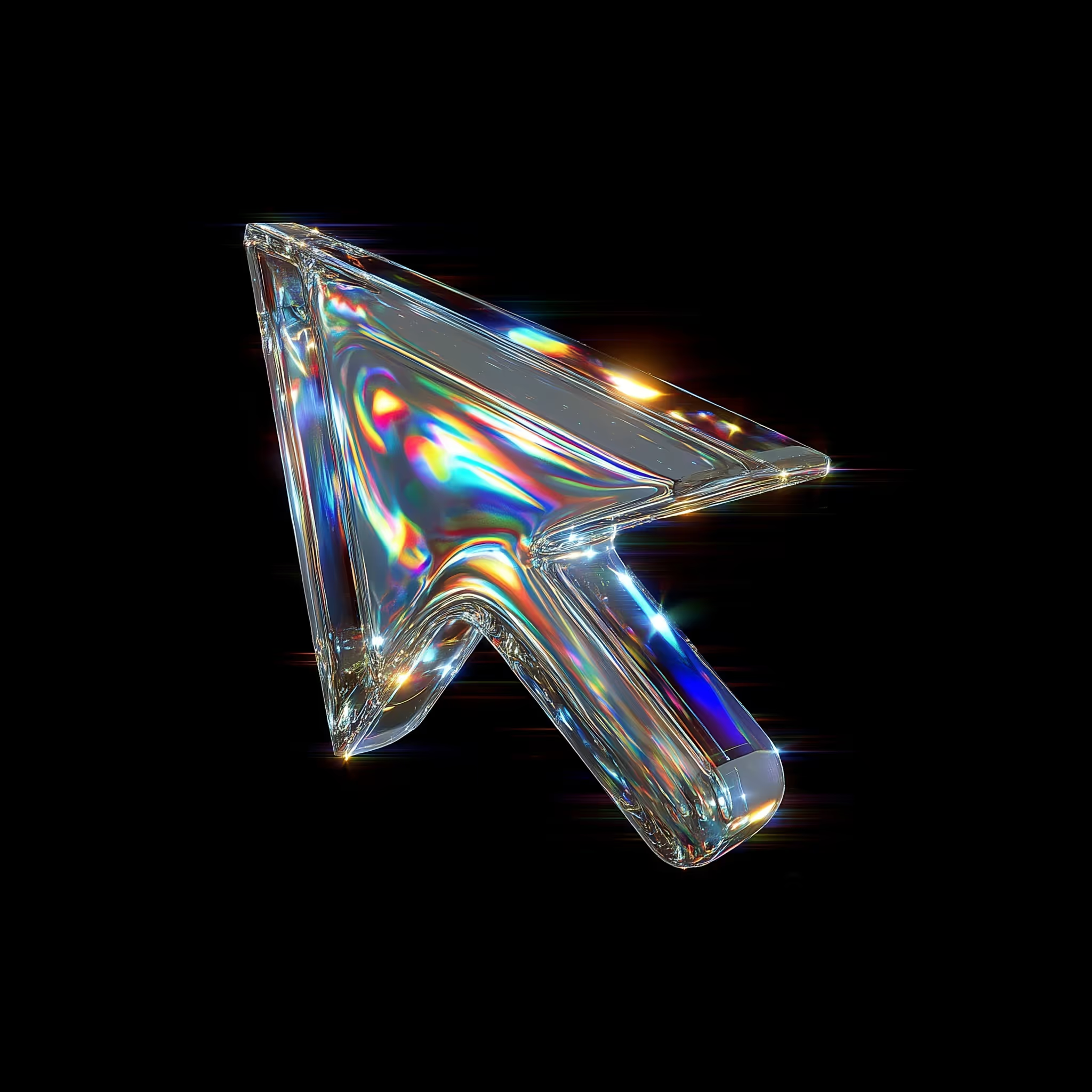
The logotype uses custom letterforms with tapered strokes that suggest velocity — thinner at the origin, thicker at the terminus, as if each letter is accelerating across the page. The 'C' serves as a standalone brand mark: a single flowing curve that implies continuous motion, like a frame extracted from a longer animation. It works at favicon size and billboard scale because its form is both simple and dynamic.
The supporting grid system is based on wave mathematics — sinusoidal curves that create dynamic layouts even in print. No two applications look identical because the wave parameters shift with each piece, but they all feel connected through shared mathematical DNA. The result is a system that's generative and varied while maintaining unmistakable visual coherence.
The color palette uses deep navy as a base — referencing the dark interfaces of professional motion software — with vibrant gradient accents that shift across the spectrum. The gradients follow the same wave mathematics as the grid, creating color transitions that feel like motion captured mid-flow rather than static color blocks.
Animation Toolkit
We delivered a comprehensive motion toolkit alongside the static identity: logo animations at five different durations (bumper, short, standard, extended, and cinematic), a transition library with 30 pre-built animations using the brand's motion principles, particle system presets calibrated to the brand's visual language, and a detailed set of motion principles that any animator on the team can apply consistently to new work.
The toolkit was built in After Effects and exported as Lottie files for web use, ensuring the animations could be implemented across every digital touchpoint without requiring motion design expertise from the development team. The website, email signatures, and social media templates all use animations from this shared library, creating consistency that reinforces the brand at every encounter.
Conclusion
The new identity helped Cascade land three major title sequence commissions within four months of launch, including a Netflix original series and a feature film that premiered at TIFF. In each case, the creative directors cited the studio's brand presentation as a factor in the hiring decision. The brand communicated the studio's capability and aesthetic sensibility before a single frame of work was reviewed.
The motion toolkit became an internal language that unified the studio's output. Every piece of work that leaves Cascade carries the same kinetic DNA, even when created by different team members on different projects. The brand principles give individual animators creative freedom while ensuring that everything feels unmistakably Cascade. New hires can produce on-brand work within their first week because the system is intuitive and well-documented.
Perhaps most significantly, the project expanded Cascade's market. The brand now works in physical installations, live events, and spatial experiences — contexts they hadn't pursued before because their old identity had no language for non-screen applications. The wave-based grid system and the kinetic typography translate naturally to large-format printing, environmental graphics, and projection mapping, opening revenue streams that didn't exist before the rebrand.
"Our old brand was static in every sense. Gallery gave us an identity that moves — conceptually, visually, and commercially."
— James Thornton, Founder, Cascade Studios